You want to use the best surgical stapler for your surgery. New studies show the linear stapler causes fewer problems and less pain for stomach patients than the circular stapler. Safety is very important. People worry about staples not forming right, staple lines not finished, the device getting stuck, tissue getting hurt, and mistakes from clamping on tissue that is too thick or thin. These problems can be very bad for patients. Picking the right stapler helps the surgery work better and keeps patients safer.
Key Takeaways
- Pick a linear stapler for stomach surgeries. It helps make strong closures and lowers problems.
- Use a circular stapler for fast anastomosis in surgeries. Watch the tissue thickness to stop leaks.
- Choose the right stapler for the patient’s tissue and surgery. This helps keep patients safe and helps them heal.
- Think about the cost and if staplers are easy to get when planning surgeries. This helps make sure the best tools are used.
- Learn about new stapler technology often. This can help make surgeries safer and better for patients.
Stapler Types
Linear Stapler Overview
A linear stapler closes tissue in a straight line. It helps seal the ends of organs like the stomach and intestines. You can use it in open or minimally invasive surgeries. Linear staplers make a strong closure. This lowers the chance of leaks for gastric patients. Surgeons trust linear staplers for cutting and removing tissue. Many doctors pick linear staplers because they work well in stomach surgeries and keep patients safe.
Tip: Linear staplers do not cut tissue. They only close it. This makes them good for closing stumps after removing part of the stomach or intestines.
Circular Stapler Overview
A circular stapler joins two hollow organs together. It can cut and staple at the same time. You often see circular staplers in stomach surgeries. They are used when reconnecting the stomach or intestines. The EEA circular stapler has a shaft, stapling head, and anvil choices. You can change these parts for different patients and surgeries. Circular staplers make a round staple line. This helps you make neat connections in stomach and colorectal surgeries.
Note: Circular staplers are important for joining tissues and vessels. They are used in stomach and hemorrhoid treatments.
Main Surgical Uses
Both linear and circular staplers are used in many surgeries. Here is a table that shows their main uses:
| Stapler Type | Functionality | Applications |
|---|---|---|
| Linear Stapler | Used for closing tissue without cutting | Closing stumps of bronchi, esophagus, stomach, duodenum, intestines, and blood vessels |
| Circular Stapler | Can cut and staple | Used in hemorrhoid treatment and stomach surgeries |
Doctors use these staplers in stomach, colon, and chest surgeries. They also use them for rebuilding the digestive tract and making cuts during liver surgery. Patients get safer and better surgeries because of these tools.
Linear Stapler vs Circular Stapler Comparison

Effectiveness
You want good results for stomach surgery. Both staplers help close and join tissues. In laparoscopic gastrectomy, they work differently. The linear stapler makes a strong closure for rebuilding the digestive tract. Many patients get a wider anastomosis with the linear stapler. This lets food move more easily after surgery. The circular stapler makes a neat, round connection. You finish the anastomosis faster with the circular stapler. You can see how effective each stapler is in the table below:
| Stapler Type | Anastomotic Leakage Rate | Postoperative Complications | Operative Time |
|---|---|---|---|
| Circular | Lower (3.6%) | More bleeding and wound problems | Shorter |
| Linear | Higher (8.0%) | About the same overall | Longer |
The circular stapler has a lower leakage rate in stomach surgery. The linear stapler gives similar overall complications after surgery. You spend more time using the linear stapler. You need to think about these things when picking a stapler for gastrectomy.
In gastrojejunal anastomosis, the linear stapler helps patients recover faster and have fewer problems. You can see the comparison in the table below:
| Outcome | Linear Stapler Group | Circular Stapler Group |
|---|---|---|
| Operation Time | Shorter | Longer |
| Postoperative Recovery | Faster | Slower |
| Complications | Fewer | More |
| Anastomotic Width | Wider | Narrower |
| First Exhaust Time | Earlier | Later |
| First Water Intake Time | Earlier | Later |
| Incidence of Gastroparesis | Lower (3.2%) | Higher (6.2%) |
| Anastomosis-related Complications | Lower (0.7%) | Higher (8.2%) |
| Quality of Life Impact | No big difference | N/A |
The linear stapler group has fewer problems and faster recovery. Patients get wider anastomosis and eat sooner. The circular stapler group has more problems and slower recovery after gastrectomy.
Safety
Safety is very important for patients. You want to avoid bleeding, leakage, and tissue injury. The linear stapler lets you pick staple heights. You match the stapler to the thickness of the tissue. This helps prevent problems in stomach and digestive tract reconstruction. The circular stapler cuts and staples at the same time. You finish the anastomosis quickly. You must check tissue thickness before using the circular stapler. Using a bigger circular stapler or manual technique can cause more leakage.
Tip: You make surgery safer by matching the stapler to the patient’s tissue and the type of gastrectomy.
There is no big difference in safety between two- and three-row circular staplers. The single-stapling technique works better than the double-stapling technique. You must pay attention to stapler technology and technique to keep patients safe.
Complication Rates
You want to lower problems after surgery for patients. Both staplers have risks. You can see the complication rates in the table below:
| Stapler Type | Total Complications | Anastomotic Complications | Gastrointestinal Motility Complications | Other Complications |
|---|---|---|---|---|
| Linear Stapler | 14 | 2 | 6 | 6 |
| Circular Stapler | 16 | 4 | 7 | 5 |
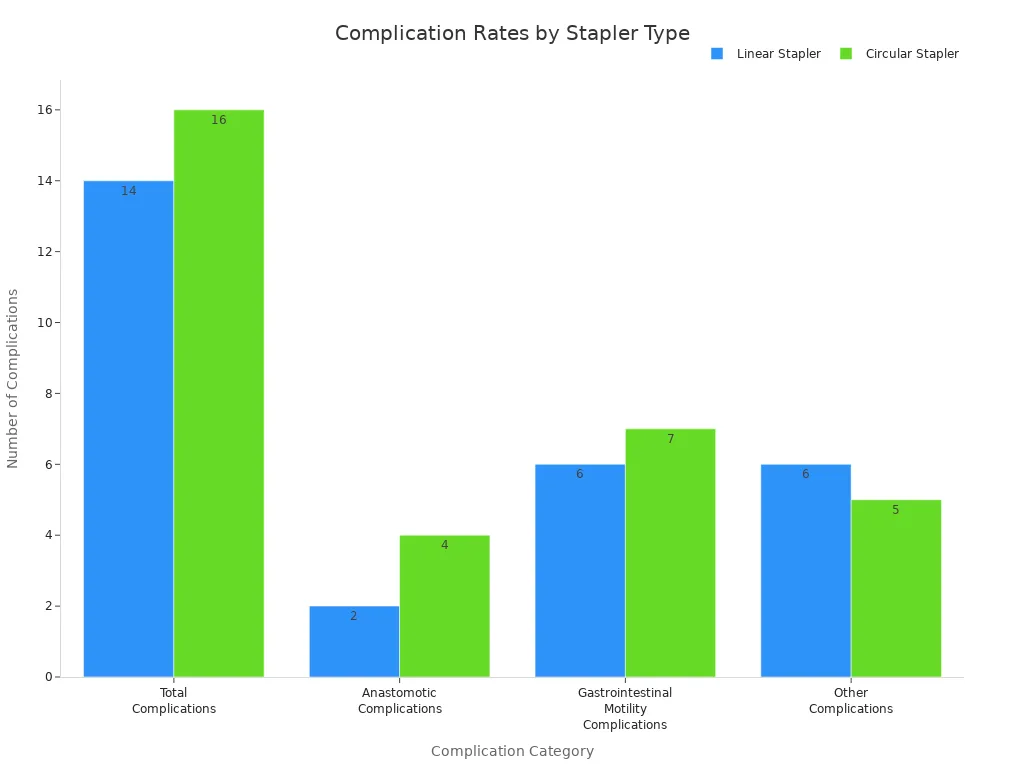
The linear stapler has fewer total problems and fewer anastomotic problems. The circular stapler has more motility problems after gastrectomy. You need to watch for these issues in patients after digestive tract reconstruction.
Common problems include:
- Bigger circular staplers and manual technique cause more leakage.
- Single-stapling technique lowers leakage compared to double-stapling.
- No big difference in leakage between two- and three-row circular staplers.
You must pick the right stapler and technique to lower problems for patients.
Ease of Use
You want a stapler that is easy to use and fits the surgery. The linear stapler lets you pick staple heights. You adjust for different tissue thicknesses in stomach and digestive tract reconstruction. You get strong tissue compression with the linear stapler. This lowers bleeding and dehiscence. The circular stapler cuts and staples at the same time. You finish the anastomosis faster. You must check tissue thickness before using the circular stapler.
- Linear stapler lets you pick staple height for thick or thin tissue.
- You get strong tissue compression with the linear stapler.
- Circular stapler speeds up anastomosis but needs careful tissue selection.
You must balance ease of use, safety, and effectiveness when picking a stapler for gastrectomy. You help patients get better results and quality of life after digestive tract reconstruction.
Stapler Choice
Gastrointestinal Surgery
You have to pick the best stapler for stomach surgery. Most doctors like the linear stapler for fixing the digestive tract. It gives a strong closure and fewer problems after surgery. The linear stapler is good for straight connections in gastrectomy. You can change staple height for thick or thin tissue. This helps stop leaks and bleeding. Experts agree that making the staple line stronger lowers bleeding and leaks. You get better results after surgery if you use reinforcement. Some doctors use stitches for extra support, but not everyone does this. You should think about cost and research before you decide.
Note: You make surgery safer and better by matching the stapler to the patient’s tissue and the type of stomach surgery.
Thoracic Surgery
Doctors use the linear stapler for straight cuts in chest surgery. It helps make side-to-side connections with bigger openings. This lowers problems and helps patients feel better after gastrectomy. The circular stapler is best for round connections. You use it to join hollow organs in mechanical anastomosis. You finish connecting faster with the circular stapler. You must check how thick the tissue is before using it. Both staplers help rebuild the digestive tract and fix the stomach.
- Linear stapler: Best for straight connections and chest surgery.
- Circular stapler: Made for round connections and stomach surgery.
Colorectal Surgery
You need to pick a stapler based on proof from studies. The powered circular stapler lowers leaks compared to manual staplers. You see fewer problems after surgery and better safety for patients. The table below shows the difference:
| Stapler Type | Anastomotic Leakage Rate | Bleeding Rate | Odds Ratio (OR) for Leakage | Number Needed to Treat (NNT) |
|---|---|---|---|---|
| Powered Circular | 4.6% | 4.99% | 0.38 (95% CI 0.26–0.55) | 20 |
| Manual Circular | 7.74% | N/A | N/A | N/A |
Doctors use the circular stapler for joining the colon. You get fewer leaks and fewer problems. You must watch for tight tissue and poor blood flow in patients.
Other Procedures
You face special problems in weight loss, chest, and general surgeries. You must pick the stapler based on tissue thickness and how strong it is. The linear stapler works well for stomach surgery with different tissue thickness. You use the circular stapler for even tissues in colon and stomach surgery. You need a stapler that works for many types of surgery. Bioabsorbable staplers help close cuts faster in busy hospitals. Disposable staplers help close wounds quickly in bone surgery. You must match the stapler to the patient to lower problems and help them heal better.
Tip: You keep patients safe and help them heal by picking the right stapler for each surgery and person.
Clinical Evidence
Key Studies
Many studies compare the linear stapler and circular stapler in stomach surgery. Researchers look at gastrectomy and how each stapler affects patients. The linear stapler helps rebuild the digestive tract and lowers problems after surgery. Patients recover faster after gastrectomy with the linear stapler. There are fewer problems and a better quality of life. The circular stapler helps with mechanical anastomosis and makes the process quicker. Some studies show more problems after gastrectomy with the circular stapler, especially in digestive tract reconstruction. You need to check how each stapler affects patients after surgery.
Note: Picking the right surgical stapler for gastric reconstruction helps patients. Studies show the linear stapler lowers problems after surgery and helps patients recover.
Expert Recommendations
Experts give advice based on new clinical evidence. Surgeons should match the stapler to the patient’s tissue and the type of gastrectomy. You must think about the risk of problems and the need for strong reconstruction. Experts say to use the linear stapler for rebuilding the digestive tract in stomach surgery. You get fewer problems after surgery and better results. The circular stapler works well for mechanical anastomosis in stomach and colon surgery. You must check tissue thickness and blood flow before using any stapler.
Here is a table that shows important points for surgeons and patients:
| Document Focus | Key Implications for Surgeons and Patients |
|---|---|
| Atrial Functional Mitral Regurgitation | You get a plan for diagnosis and management, helping treatment choices. |
| Management of MAC | You see a simple outline for picking patients and therapy, guiding surgery. |
| Surgical Treatment of ATAAD | You improve care in emergencies, changing surgery steps. |
| Periprocedural Anticoagulation in Congenital Heart Disease | You find practice differences and new advice, affecting patient results. |
| PAIVS Management | You focus on the best surgery and care after, improving patient management. |
| Complications of AMI | You learn about mechanical support, shaping treatment plans. |
| Donor Lung Procurement | You follow clear advice for lung preservation, influencing surgery. |
| N2-positive Non-small Cell Lung Cancer | You address team care and treatment together, affecting surgery choices. |
You help patients by following expert advice and using clinical evidence. You lower problems and help patients get better after gastrectomy and digestive tract reconstruction.
Practical Considerations
Selection Factors
You have to pick the right surgical stapler for stomach surgery. This choice can change how patients feel after surgery. It also affects how well they recover. You need to use the stapler that fits the surgery. If you need to cut stomach tissue or join organs, you pick a linear stapler or a circular stapler. You look at the type and condition of the tissue. How thick or weak the stomach tissue is helps you choose the staple height. You check if you have enough space to use the stapler. You make sure the stapler fits in the area where you are working. You want the stapler to work the same way every time. Good staplers help lower problems and make stomach repair better. You think about how the stapler fits into your work. You want a stapler that saves time and helps the surgery go smoothly. You also think about how much the stapler costs. You compare the price to how much it helps the patient and the surgery.
- Pick the stapler that matches the surgery.
- Think about the tissue type and condition.
- Check if you have enough space to use the stapler.
- Make sure the stapler works well every time.
- See if the stapler helps you work faster.
- Compare the cost to how much it helps.
Tip: You help patients get better after surgery by picking the stapler that fits their needs and the type of stomach surgery.
Cost and Availability
You may have trouble with cost and finding staplers for stomach surgery. High prices make it hard for some hospitals to buy new staplers. If staplers are not always there, it can mess up surgery plans. It also makes it hard for all hospitals to use the same tools. Surgery centers like staplers that cost the same and are easy to get. This means they may not use the best staplers even if doctors want them. Rules and buying steps can slow down getting new staplers. This can make surgery take longer and make it harder to fix the stomach. Powered staplers cost about $300 to $600 each time you use them. Manual stapler parts cost about $150 to $400 each time. Powered systems cost about $18 to $28 each time. Manual ones cost about $8 to $15 each time. You need to think about these things when you plan stomach surgery or join organs. You help patients by thinking about cost, if you can get the stapler, and the chance of problems.
- High prices make it hard for some hospitals to buy staplers.
- Not having staplers can mess up surgery plans.
- Surgery centers want staplers that are easy to buy and cost the same.
- Rules can slow down getting new staplers.
- Powered staplers cost $300 to $600 each time.
- Manual parts cost $150 to $400 each time.
- Powered systems cost $18 to $28 each time.
- Manual ones cost $8 to $15 each time.
Note: You help patients and lower problems by thinking about cost and if you can get the stapler when you pick tools for stomach surgery.
You can get better gastrectomy results by picking the right stapler. The linear stapler works well for fixing the stomach and intestines. It gives strong closure and fewer problems. The circular stapler helps finish anastomosis faster in stomach and colon surgeries. You need to watch for problems with the circular stapler. You see better results after surgery when you match the stapler to the patient and surgery type. Surgeons should use absorbable staplers to make surgery quicker and lower problems in stomach procedures. New things like 3D staples, powered staplers, and bioabsorbable materials help lower problems and make gastrectomy safer. You should talk with your surgical team to pick the best stapler for your stomach surgery.
| Procedure | Best Stapler | Complications Rate | Postoperative Outcomes |
|---|---|---|---|
| Gastric gastrectomy | Linear stapler | Lower | Faster recovery |
| Colorectal anastomosis | Circular stapler | Lower leakage | Improved healing |
| Gastrointestinal reconstruction | Linear stapler | Fewer | Better function |
- New stapler technology helps close tissue and lowers problems.
- Powered and bioabsorbable staplers make stomach surgery safer.
Tip: Always ask your surgical team which stapler is best for your stomach surgery.
FAQ
What is the main difference between a linear stapler and a circular stapler?
You use a linear stapler to close tissue in a straight line. You use a circular stapler to join two hollow organs with a round connection. Each stapler fits different surgeries.
Which stapler is safer for stomach surgery?
You get safer results with a linear stapler for most stomach surgeries. You can adjust staple height for thick or thin tissue. This lowers the risk of leaks and bleeding.
Can you use both staplers in one surgery?
You may see surgeons use both staplers in complex surgeries. Each stapler helps with different steps. You get better results when you match the stapler to the tissue and procedure.
How do you choose the right stapler for your surgery?
You look at the type of surgery, tissue thickness, and the surgeon’s experience. You ask your surgical team which stapler works best for your needs.